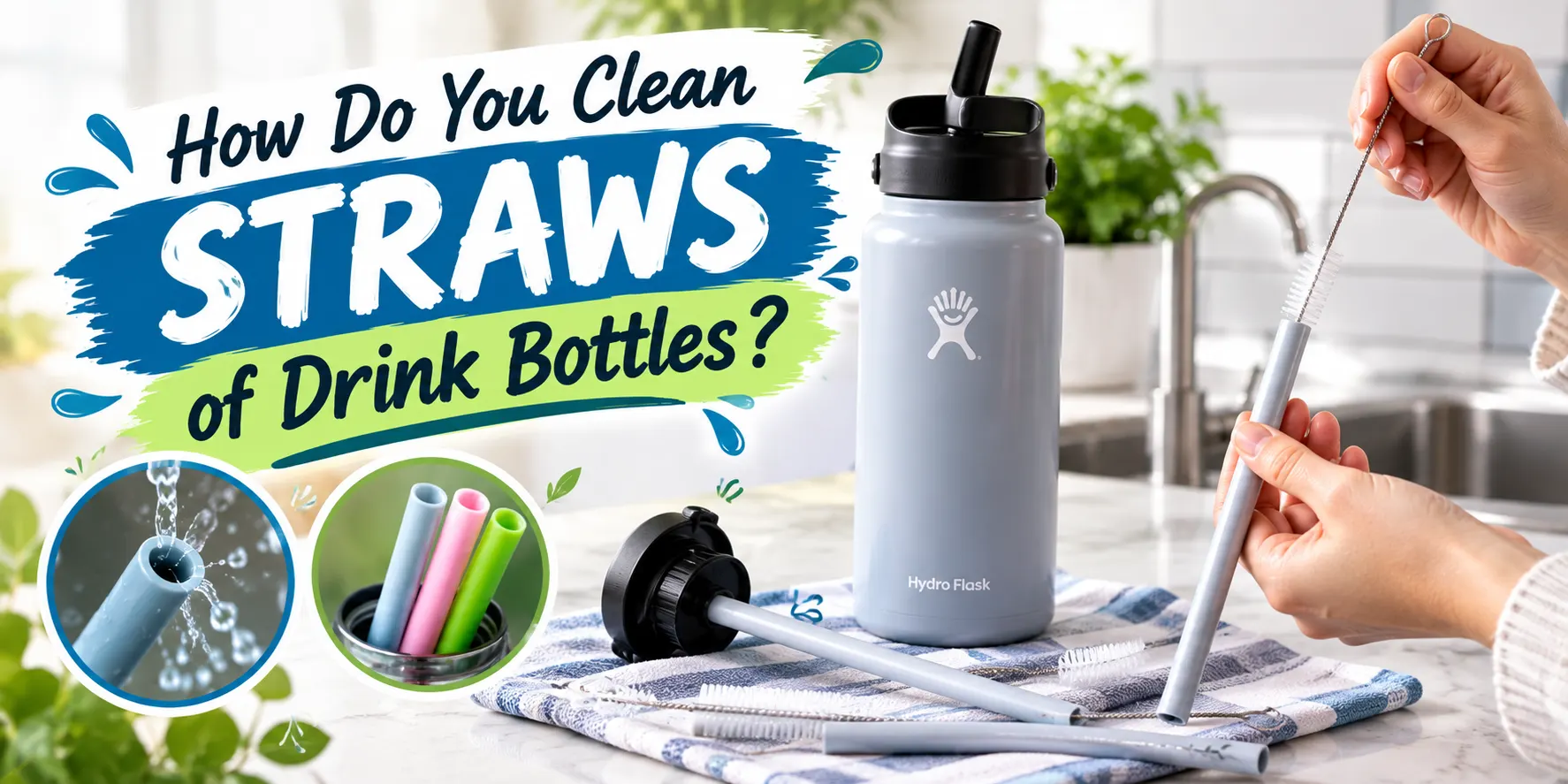
Your reusable water bottle straw gets used often, but it is also one of the easiest parts of a bottle to overlook when cleaning.
Because straws are narrow and can stay damp inside, they may collect drink residue, bacteria and buildup over time. Flavored drinks, juice and other sugary beverages can leave even more residue behind.
The good news is that cleaning a reusable straw does not have to be complicated. A simple routine of soap, water, scrubbing, rinsing and thorough drying can help keep your bottle cleaner.
Here is how to clean a water bottle straw, deal with visible buildup and prevent the problem from coming back.
Why Do Water Bottle Straws Get Dirty?
A straw has a small interior space where moisture and leftover drink residue can remain after use. If the straw stays wet inside a closed bottle, bacteria and other buildup can develop over time.
This can happen more easily when you use the bottle for juice, sports drinks, flavored water or other beverages that leave residue.
The main problem is often not the straw itself but moisture and residue that are allowed to remain inside it.
Signs Your Straw Needs a Deep Clean
Your straw may need more than a quick rinse if you notice:
Black, green, white or other unusual spots
A musty or unpleasant smell
An unusual taste
Slimy or sticky buildup
Residue that remains after normal washing
If you notice visible mold or buildup that you cannot remove completely, stop using the straw until it has been thoroughly cleaned. If it cannot be cleaned properly, replacing it may be the better option.
How to Clean a Water Bottle Straw Every Day
You do not need a complicated cleaning routine for everyday care. The most important thing is to clean the parts that come into contact with your drink and allow them to dry completely.
Step 1: Take the Bottle Apart
Remove the straw, lid, mouthpiece, gasket and any other removable parts.
Check your bottle's instructions first, especially if it has small silicone seals or special components.
Step 2: Wash With Soap and Water
Use warm water and dish soap to wash the bottle and its removable parts.
For the straw, use a straw-cleaning brush that fits inside the tube. Move the brush through the entire length of the straw to remove residue from the inside.
Water alone may rinse away some leftover drink, but scrubbing helps remove buildup that sticks to the interior.
Step 3: Rinse Thoroughly
Rinse every part with clean water until no soap remains.
Pay special attention to small openings, grooves and the inside of the straw.
Step 4: Let Everything Dry Completely
Place the parts somewhere clean and allow them to air dry completely before putting the bottle back together.
This step is especially important because trapped moisture can contribute to future buildup and unpleasant odors.
If your bottle and parts are labeled dishwasher-safe, you can also use the dishwasher according to the manufacturer's instructions.
How to Deep Clean a Moldy or Smelly Straw
If you find visible mold, a strange odor or stubborn buildup, start with thorough washing and scrubbing.
For hard, washable parts, soap and water can remove visible mold and residue. The CDC recommends cleaning mold from hard surfaces with household products or soap and water, while emphasizing the importance of removing the moisture problem that allows mold to grow.
Method 1: Vinegar Soak
If your bottle manufacturer allows vinegar for the material, you can use a diluted white vinegar solution as an additional cleaning step.
Disassemble the bottle completely.
Wash the straw, lid, gasket and other removable parts with warm water and dish soap.
Scrub the inside of the straw with a straw brush.
Soak suitable parts in a mixture of equal parts white distilled vinegar and water.
Rinse everything thoroughly with clean water.
Allow all parts to air dry completely before reassembling.
Vinegar can be useful for dealing with odors and some buildup, but scrubbing and rinsing are still important. Do not assume soaking alone will remove all residue.
Method 2: Manufacturer-Approved Bleach Cleaning
Bleach should not be treated as a universal solution for every bottle or straw. Some materials may not be compatible with it.
If your bottle manufacturer specifically allows bleach:
Wash the parts with soap and water first.
Follow the bottle manufacturer's instructions and the bleach product label for the correct dilution and contact time.
Use good ventilation while working with bleach.
Rinse the parts thoroughly with clean water afterward.
Allow everything to dry completely before using the bottle.
Do not use a random bleach concentration or a fixed soaking time unless it is specifically recommended for your product.
Most importantly, never mix bleach with vinegar, ammonia or other cleaning products. Mixing bleach with other cleaners can create dangerous vapors.
Don't Forget the Lid, Gasket and Mouthpiece
Cleaning only the straw is not enough if the rest of the bottle is dirty.
Small areas around the lid, mouthpiece, threads and silicone gasket can collect moisture and drink residue.
When cleaning your bottle:
Remove the gasket if the manufacturer says it is removable.
Wash around the mouthpiece and lid openings.
Clean grooves and threads where residue may collect.
Scrub removable silicone parts with soap and water.
Rinse every part thoroughly.
Let the pieces dry separately before reassembling them.
These small parts can be easy to overlook, so checking them regularly can make your cleaning routine much more effective.
How Often Should You Clean a Reusable Straw?
For everyday use, a simple routine works well:
After each use: Wash the bottle, straw, lid and removable parts with soap and water.
Regularly: Give the straw, gasket, mouthpiece and other small parts a more thorough scrub.
After sugary or flavored drinks: Clean the bottle as soon as practical instead of allowing residue to sit inside.
When you notice a problem: Deep-clean the bottle if you notice an odor, visible buildup, unusual taste or discoloration.
There is no need to rely on a single weekly rule for every bottle. How often you need a deeper clean depends on how frequently you use the bottle, what you drink from it and how well the parts are cleaned and dried.
How to Prevent Mold and Buildup From Coming Back
Cleaning the straw is only half the job. Proper drying and storage can help prevent the same problem from returning.
1. Dry Every Part Completely
Do not immediately close up a bottle while the straw, lid or gasket is still wet.
Allow the individual parts to air dry before reassembling the bottle.
2. Store the Bottle Open
When the bottle is not being used, leave it open so moisture can escape.
Avoid sealing a damp bottle in a bag or cabinet.
3. Clean Sugary Drinks Promptly
Juice, flavored drinks and other beverages can leave residue behind.
Rinse and wash the bottle soon after using these drinks rather than allowing the residue to sit inside.
4. Clean the Hidden Parts
Do not focus only on the main bottle and straw. Gaskets, mouthpieces and lid grooves can also collect moisture and residue.
5. Inspect the Straw Regularly
Look inside the straw occasionally, especially if it is difficult to see through.
If you notice persistent discoloration, cracking or buildup that cannot be removed, consider replacing the straw.
When Should You Replace a Reusable Straw?
Sometimes cleaning is not enough.
Consider replacing the straw if:
It has cracks, splits or other visible damage.
The material has become brittle or degraded.
You cannot remove visible buildup after thorough cleaning.
An unpleasant odor remains despite proper washing and drying.
The manufacturer recommends replacing the part.
A damaged or difficult-to-clean straw can be harder to keep hygienic, so replacing a removable straw may be simpler than repeatedly trying to clean it.
Three Hydro Flask Bottles Worth Knowing (And How Easy They Are to Clean)
Not all straw lids are equally easy to keep clean — some disassemble in seconds, others trap moisture in tighter spots. Here's how three popular Hydro Flask options compare.
Hydro Flask 32 oz Wide Mouth with Flex Straw Cap
A large insulated bottle with a closeable Flex Straw Cap, flexible handle and wide opening. Hydro Flask lists the bottle as leakproof when closed, dishwasher-safe and ice-cube friendly. The Flex Straw Cap is not intended for hot liquids.
Pros:
Wide Mouth opening makes it easier to reach the inside when cleaning
Dishwasher-safe design can simplify regular cleaning
Closeable straw cap helps keep the drinking opening covered between uses
Wide opening is designed to accommodate ice cubes
Cons:
The straw and cap still need regular cleaning, including the inside of the straw
The Flex Straw Cap is not intended for hot liquids

Hydro Flask 32 oz Wide Mouth with Flex Straw Cap
A reusable insulated stainless-steel bottle with a wide mouth and Flex Straw Cap, designed for convenient everyday hydration at home, work, school, or outdoors.
Hydro Flask Micro Hydro
The Micro Hydro is a compact bottle available in 6.7 oz, 10 oz and 13.5 oz sizes. Unlike a typical straw-lid bottle, its standard design uses a screw cap, so there is no straw to scrub or dry. It is dishwasher-safe and includes a removable FlexClip bottle strap.
Pros:
No straw to clean, which means fewer small parts to maintain
Dishwasher-safe design makes routine cleaning easier
Compact sizes are useful for smaller drinks and on-the-go use
Removable FlexClip strap makes the bottle easy to carry
Cons:
It is not the right choice if you specifically want a sip-through straw
Its compact size is designed more for small servings than all-day hydration

Hydro Flask Micro Hydro 300 mL
A compact insulated bottle designed for small, convenient sips, making it easy to carry for commutes, short outings, lunches, and everyday use.
Hydro Flask Kids 12 oz Bottle
The Hydro Flask Kids 12 oz Bottle is a smaller insulated bottle with a straw cap, bottle boot and dishwasher-safe design. The standard Straw Cap version is listed as leak-resistant, while the newer Covered Cap version is listed as leakproof when closed.
Pros:
Straw cap is designed for easier everyday cleaning
Dishwasher-safe design can make regular washing more convenient
Bottle Boot provides added protection
The standard model is designed for kids ages 3 and up
The covered-cap version helps keep the drinking opening covered between uses
Cons:
The straw and cap still need regular cleaning
The standard Straw Cap version is listed as leak-resistant rather than fully leakproof
The bottle is not intended for hot liquids

Hydro Flask Kids 12 oz Bottle
A compact reusable bottle made for kids, with an easy-to-carry size that's convenient for school, activities, and everyday hydration.
Putting It All Together
Cleaning a reusable water bottle straw is mostly about consistency.
After each use, wash the straw with soap and water, scrub the inside with a suitable brush, rinse it thoroughly and let every part dry completely.
If you notice mold, unusual odors or stubborn buildup, take the bottle apart and clean the straw, lid, gasket and mouthpiece carefully. Vinegar may be useful for some materials, while bleach should only be used when the manufacturer allows it and according to the product instructions.
Never mix bleach with vinegar or other cleaning products.
Most importantly, do not put a wet straw back into a closed bottle and leave it there. Keeping the individual parts clean and dry is one of the simplest ways to reduce recurring buildup.
Frequently Asked Questions
Clean the straw and other drink-contact parts after each use with soap and water. Give the straw, lid, gasket and mouthpiece a more thorough cleaning regularly and clean them promptly if you notice odor, buildup or discoloration.
Neither should be treated as a universal answer. Start with soap, water and thorough scrubbing. If you need an additional cleaning method, check the manufacturer's instructions first. Vinegar may be suitable for some materials, while bleach should only be used when the manufacturer permits it and according to the product label.
Do not assume that boiling water is safe for every straw. Heat can damage or deform some materials. Check the manufacturer's instructions before exposing a straw or bottle component to very high temperatures.
A lingering smell may mean that residue remains inside the straw or in another part of the bottle, such as the gasket or mouthpiece. Scrub the inside of the straw with a suitable brush, clean the removable parts, rinse thoroughly and allow everything to dry completely.
Some reusable straws and bottle parts are dishwasher-safe, while others are not. Check the manufacturer's instructions before putting them in the dishwasher.
Visible mold or unusual buildup is a reason to stop using the straw until it has been thoroughly cleaned. If the straw cannot be cleaned completely or remains damaged, replacing it is a practical option.
You can rinse and wash a straw without a brush, but a properly sized straw brush is more effective at reaching residue inside a narrow tube.