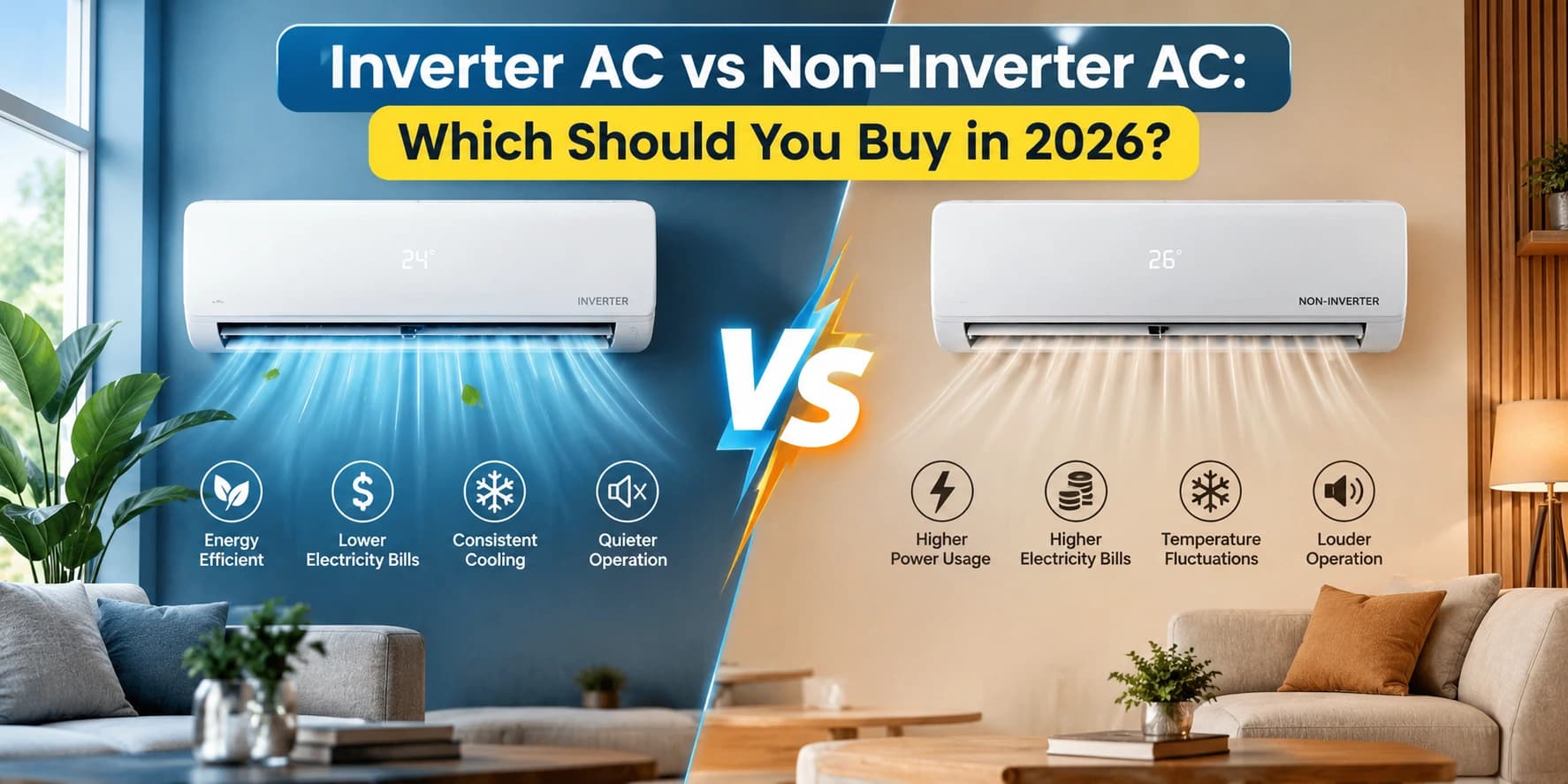
Choosing between an inverter AC and a regular non-inverter AC can be confusing. While they may look the same, they work differently and can have a big impact on your electricity bill.
In this guide, we'll explain how each type works, compare costs and help you decide which one is the best fit for your home and budget.
Quick Answer:
If you use your AC for several hours every day, an inverter model can offer lower running costs over time. If you use AC only occasionally, a non-inverter model may provide better value because of its lower upfront price.
What's the Real Difference Between Inverter and Non-Inverter AC?
The difference comes down to the compressor — the part of the AC that does the actual cooling work.
Non-inverter AC: Runs a fixed-speed compressor that switches fully on, then fully off, to hold your room at the set temperature. Every restart draws a burst of extra power and the temperature tends to swing a few degrees between cycles.
Inverter AC: Uses a variable-speed compressor that can adjust its speed according to the cooling demand, reducing the need for frequent full-power starts and stops.
That single design difference is what drives nearly every other gap between the two — electricity bills, noise, temperature consistency and even lifespan.
Inverter vs Non-Inverter AC: Side-by-Side Comparison
Feature | Inverter AC | Non-Inverter AC |
Upfront price | Higher | Lower |
Running cost | Lower in many use cases; actual savings vary by model, climate, usage and electricity rates | Higher over time |
Energy efficiency | Generally higher due to variable-speed operation | Lower because the compressor repeatedly starts and stops |
Cooling style | Gradual, steady temperature | On/off cycling, more temperature swing |
Temperature stability | More consistent room temperature | Greater fluctuations around the set temperature |
Startup power consumption | Lower, as the compressor ramps up gradually | Higher due to frequent full-power starts |
Noise level | Quieter, especially at low speed | Louder start-up and cycling noise |
Compressor lifespan | Generally longer with proper maintenance | Shorter, more on/off wear and tear |
Repair complexity/cost | More electronic components (PCB, inverter drive) — repairs can cost more | Simpler mechanically — repairs are often cheaper and easier to find a technician for |
Smart features availability | More commonly includes Wi-Fi, app control and smart-home integration | Available on some models, but generally less common |
Best for | Rooms used 6+ hours a day or all day (living rooms, bedrooms, home offices) | Occasional use spaces (guest rooms, weekend homes, garages) |
Why Inverter ACs Save You Money (Eventually)
An inverter AC uses less electricity because it adjusts its speed instead of turning on and off all the time. This can help reduce energy costs, with many models saving around 20–30% on power bills during regular use.
The downside is that inverter ACs usually cost more to buy. If you use your AC for many hours every day, the energy savings can make up for the higher price over time.
But if you only use your AC occasionally, a non-inverter model may be the more cost-effective choice.
Why Non-Inverter ACs Still Make Sense for Some Buyers
Non-inverter isn't "outdated" — it's just simpler and simple has real advantages:
Lower purchase price, which matters a lot if you're outfitting multiple rooms or a rental property
Fewer electronic parts to break and technicians everywhere know how to fix them
Voltage protection matters for both types. In areas with unstable power, check the manufacturer's voltage requirements and whether additional protection is recommended.
Fine for light, occasional use — a guest room or garage doesn't need the efficiency of an inverter compressor if it's only running a few hours a week
How to Decide: 4 Questions to Ask Before You Buy
How many hours a day will it actually run? 6+ hours daily leans inverter. A few hours here and there leans non-inverter.
What's your budget right now vs. over time? Tight upfront budget with room to absorb electricity costs later → non-inverter. Willing to pay more now to spend less monthly → inverter.
How sensitive are you to noise? Bedrooms and home offices benefit noticeably from an inverter's quieter operation.
How long do you plan to keep the unit? The longer you'll own it, the more an inverter's efficiency and lifespan advantages compound in your favor.
Sizing Still Matters More Than the Compressor Type
Before choosing between an inverter and a non-inverter AC, make sure you pick the right size for your room. An AC that is too large or too small will waste energy and may not cool the room properly.
Room size, ceiling height, sunlight and the number of people using the space all affect the cooling capacity you need. Even the most efficient inverter AC will not perform well if it is the wrong size for the room.
Common Mistakes to Avoid
Buying inverter for the label without checking daily usage hours — you may never recoup the premium
Skipping the wattage/BTU check and assuming a bigger number always means better cooling
Ignoring installation and maintenance costs, which can vary between the two types
Not comparing verified deals before buying — AC prices fluctuate seasonally and waiting for a sale (or using a verified coupon) can offset a big chunk of the inverter price premium
Inverter vs Non-Inverter AC at a Glance
Choose an Inverter AC if:
You use AC 6+ hours daily
Lower electricity bills are important
You want quieter operation
You plan to keep the AC for several years
Choose a Non-Inverter AC if:
Upfront cost is your top priority
The room is used occasionally
Simpler repairs matter more than efficiency
You are buying for a rental or guest room
Featured Inverter AC Picks
If you've decided inverter is the right call for your home, here are two solid options depending on how much space you're cooling.
This is the pick if you're cooling multiple rooms — living room, bedroom and a home office, for example — off a single outdoor unit. It's a true inverter compressor with WiFi and Alexa/Google Assistant control, 7 modes, 8 fan speeds and a built-in outdoor heater that keeps it running down to -4°F and up to 131°F. Indoor noise stays under 30 dB.
COSTWAY 27,000 BTU 3-Zone Mini Split
Pros:
Independent temperature control for 3 rooms from one outdoor condenser — cheaper than installing 3 separate single-zone systems
Smart app + voice control (Alexa/Google Assistant) plus a 24-hour timer for scheduling
Wide operating range (cools to 131°F, heats to -4°F) thanks to the built-in outdoor heater
Whisper-quiet indoor units (under 30 dB) for bedrooms
Cons:
Higher upfront investment than a single-zone unit — this is a multi-room system, not a budget buy
Requires professional HVAC installation (line sets, electrical, mounting)
Runs on 208-230V, so you may need an electrician to run new wiring if your home doesn't already have it
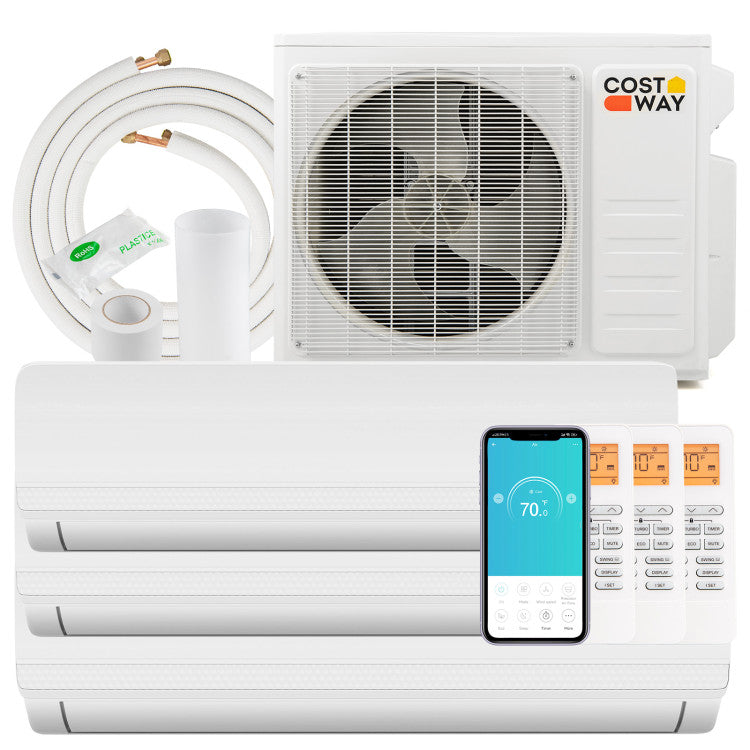
27,000 BTU 3-Zone Mini Split AC – 19 SEER2 WiFi Inverter with Heat Pump
A powerful 3-zone ductless mini split system designed to provide flexible heating and cooling across multiple rooms. It features 27,000 BTU capacity, 19 SEER2 efficiency, WiFi connectivity, inverter technology, a 24-hour timer, and a heat pump for year-round comfort.
COSTWAY 12,000 BTU Mini Split
Pros:
Budget-friendly entry point into inverter technology
Runs on standard 115V household power — no need for a dedicated 230V circuit in most homes
Very quiet at 23 dB, with a display-off mode for undisturbed sleep
WiFi + Alexa/Google Assistant control, 7 modes, 6 fan speeds, self-cleaning at 133°F
Cons:
Single-zone only — one indoor unit, one room
Still requires professional installation (not a plug-and-play window unit)
600 sq. ft. coverage caps it out for larger open-plan spaces
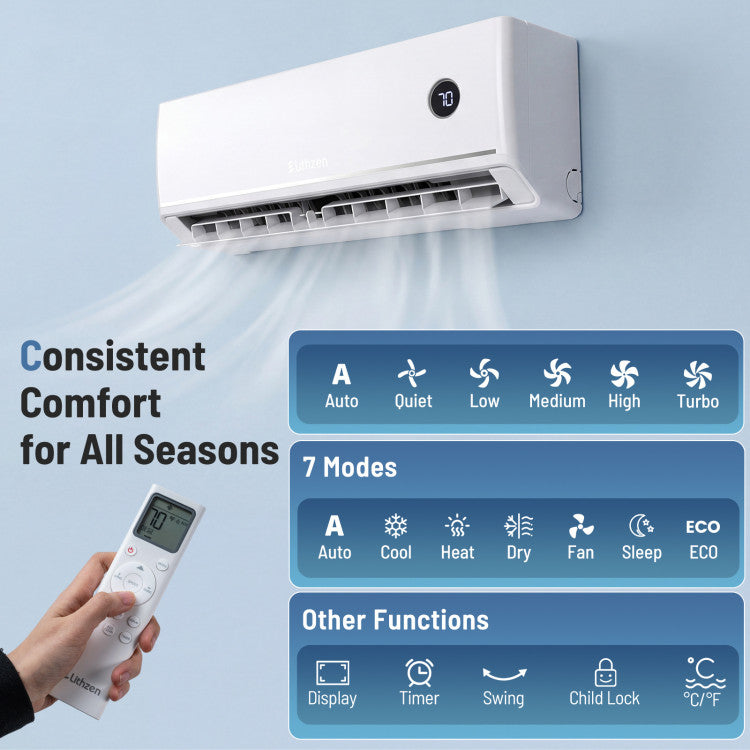
12,000 BTU 18.1 SEER2 Mini Split AC – 115V WiFi with Alexa
A compact ductless mini split air conditioner and heater designed for spaces up to approximately 600 square feet. It delivers 12,000 BTU cooling and heating, 18.1 SEER2 efficiency, 115V operation, and smart-home compatibility with Alexa for convenient control.
Final Verdict
If you run your AC frequently, an inverter model may offer lower running costs and more consistent, quieter operation over time. If your AC use is occasional or your upfront budget is the main concern, a non-inverter model can still be a practical choice.
Frequently Asked Questions
Yes, if you run it 6+ hours a day. The payback period depends on local electricity rates, usage hours and the price difference between models. For occasional use, the payback period stretches out and a non-inverter unit may be the better value.
Most modern inverter ACs handle minor voltage fluctuations on their own, but in areas with unstable power supply, a stabilizer is still often recommended to protect the electronics.
They have more electronic components, so repairs can be pricier and require a technician familiar with inverter systems. Non-inverter ACs are mechanically simpler and generally cheaper to service.
Most comparisons show 20–30% lower energy use versus a non-inverter unit under regular daily use, though actual savings depend on your climate, usage hours and how well-insulated the room is.
A common rule of thumb is about 20 BTUs per square foot, adjusted for ceiling height, insulation and sun exposure. Oversized or undersized units — of either compressor type — waste energy and cool unevenly.